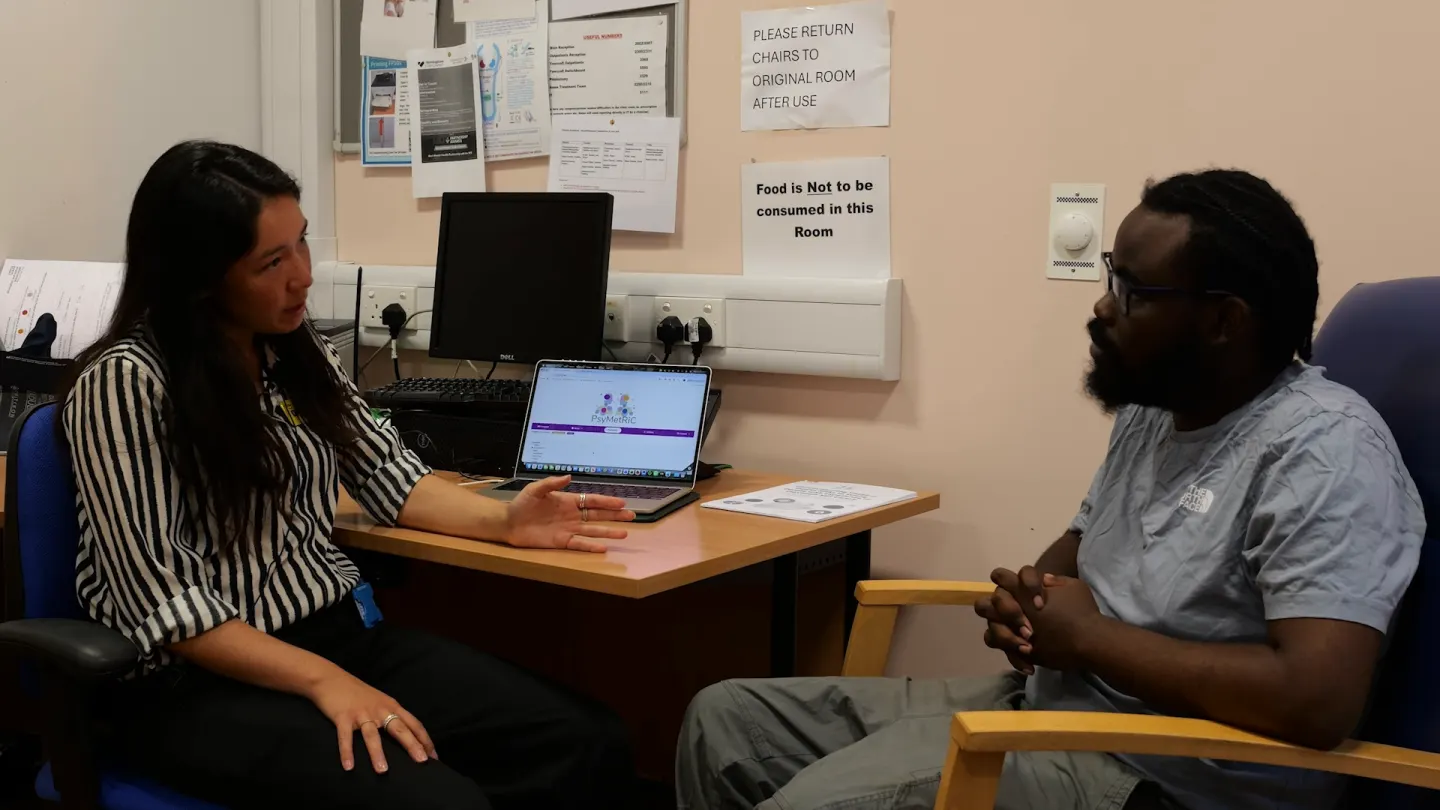
 Using PsyMetRiC in a clinical consultation.
Why early action matters
The theme for World Diabetes Day 2026 to 2027 is
“Early action on diabetes”, with a focus on early
diagnosis and risk reduction (International Diabetes Federation,
2026).
For young people with psychosis, this message is particularly
relevant. At a time when care is focused on mental health symptoms
and recovery, future physical health problems may feel like a
distant concern. Yet research suggests that changes in physical
health, such as how the body regulates glucose, may already be
present early in the illness.
Two systematic reviews and meta-analyses have found evidence of
impaired glucose regulation at the start of psychosis, including in
people who had not yet taken antipsychotic medication (Perry et al.,
2016; Pillinger et al., 2017). This suggests that attention to
physical health must begin early, with the same level of care and
attention as mental healthcare for this group.
Understanding the wider picture
Poor physical health in psychosis is shaped by several interacting
factors. These can include the metabolic effects of some medicines,
smoking, barriers to accessing healthy food and engaging in physical
activity, social disadvantage, and unequal access to physical
healthcare (Firth et al., 2019).
The burden can be substantial. A meta-analysis covering 438,245
people with schizophrenia, bipolar disorder or major depressive
disorder estimated an adjusted prevalence of type 2 diabetes of
11.3% (Vancampfort et al., 2016). This is about two to three times
as common as in the general population (Firth et al., 2019).
An individual’s physical health risk cannot be understood from
population statistics alone. Their circumstances, treatment and
priorities all matter.
The opportunity is to make physical health part of care from the
outset, with support tailored to each person.
Introducing PsyMetRiC
We built PsyMetRiC, a regulated, co-designed web application, to
estimate the risk of clinically significant weight gain, metabolic
syndrome and type 2 diabetes in people aged 16 to 35 with psychosis.
PsyMetRiC was co-produced with people with lived experience of
psychosis, carers and health professionals.
25,000+young people with psychosis in UK data used to develop and
validate PsyMetRiC
9 countrieswhere PsyMetRiC has been separately validated, across four
continents
3 outcomesweight gain, metabolic syndrome and type 2 diabetes
From research to clinical conversations
The first PsyMetRiC model, published in 2021, estimated the
likelihood of developing metabolic syndrome, a cluster of changes
affecting metabolic and cardiovascular health. It was developed
using data from two UK early intervention services and externally
validated in a third service (Perry et al., 2021). This proof of
concept study provided key evidence that a tailored tool could
accurately predict risk in this high-risk group.
In 2026, PsyMetRiC was transformed to predict outcomes that matter
most to patients, their carers, and health professionals:
-
Clinically significant weight gain within one year
- Metabolic syndrome within six years
- Type 2 diabetes within ten years
This study was conducted using data from over 20,000 individuals
with early psychosis, followed for up to 20 years, and included
detailed checks of whether PsyMetRiC is likely to work fairly across
different population groups (Perry et al., 2026).
Making risk information useful
Understanding a risk estimate is only the beginning. The next step
is a conversation about what it means for the individual and what
support may help.
PsyMetRiC presents estimates in graphical and numerical formats,
including the uncertainty around predictions. A co-designed
communication guide supports health professionals in discussing
results clearly and sensitively (University of Birmingham, 2026).
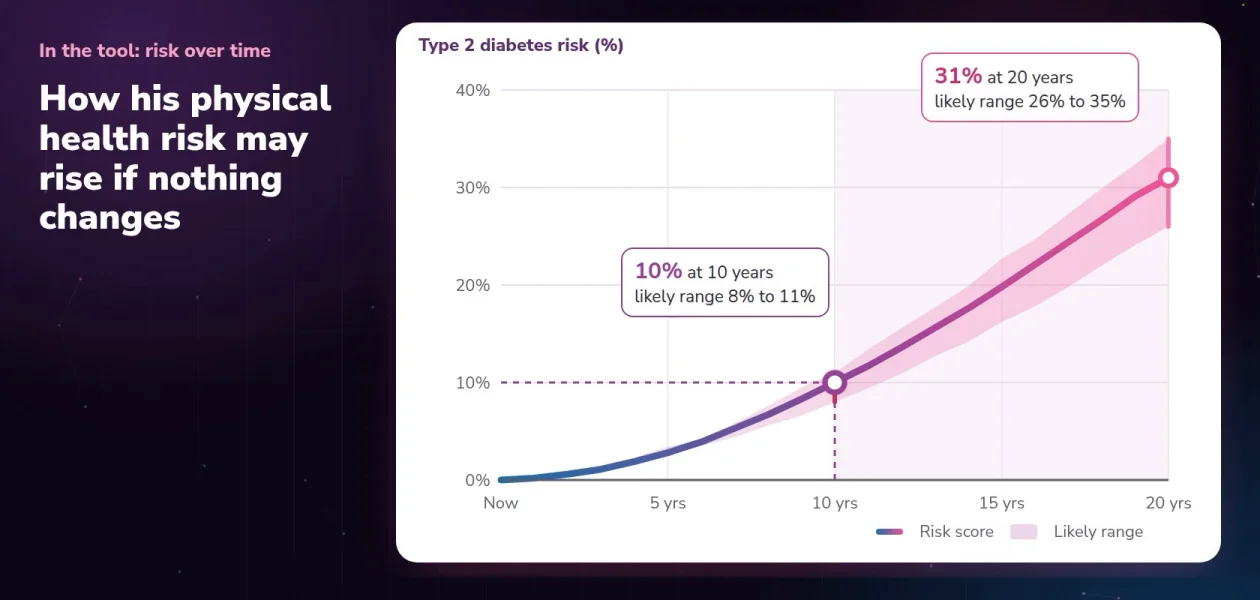 In the tool: how estimated type 2 diabetes risk may change over
time if nothing changes, shown with its likely range. Illustrative
patient, fictional teaching case.
Used alongside routine physical health checks and clinical
judgement, PsyMetRiC helps young people and health professionals:
-
See physical health risk before problems emerge,
using information teams already record.
-
Understand the risk together: how physical health
risk may rise in the years ahead, and the factors pushing the risk
score higher, and pulling it lower.
-
Compare: physical health risk with someone of a
similar background but different physical health risk factors.
-
Agree the next steps: a prevention plan that fits
everyday life, such as health behaviour support, a medication
review or closer monitoring.
PsyMetRiC supports clinical decision-making. It does not diagnose
diabetes, replace physical health monitoring or determine treatment
on its own.
Supporting the 10 Year Health Plan
In line with the NHS 10 Year Health Plan (Department of Health and
Social Care, 2025), PsyMetRiC brings prevention, community and
digital care together in one mental health care workflow:
-
Sickness to prevention: act on metabolic risk
before costly, life-shortening illness.
-
Hospital to community: mental health teams act
early and the GP hand-over carries the plan.
-
Analogue to digital: metabolic risk scored from
the patient record, inside the NHS boundary. The NHS-hosted
version is in development.
Improving physical health in severe mental illness is also
highlighted as a key NHS England target (NHS England, Core20PLUS5).
Understand early. Act together. Live healthier.
Early action begins with a conversation: understanding physical
health risk, listening to what matters to the young person and
agreeing a practical next step together. This World Diabetes Day,
we are encouraging health professionals to make that conversation
part of psychosis care from the beginning.
Working with young people with psychosis?
Contact the PsyMetRiC team to arrange a demonstration and explore
how the tool could support conversations in your service.
References
Department of Health and Social Care (2025)
10 Year Health Plan for England: fit for the future.
London: DHSC. Available at:
https://www.gov.uk/government/publications/10-year-health-plan-for-england-fit-for-the-future
(Accessed: 6 November 2026).
Firth, J. et al. (2019) ‘The Lancet Psychiatry Commission: a
blueprint for protecting physical health in people with mental
illness’, The Lancet Psychiatry, 6(8), pp. 675–712.
Available at:
https://doi.org/10.1016/S2215-0366(19)30132-4.
International Diabetes Federation (2026)
World Diabetes Day: Early action on diabetes. Available
at:
https://worlddiabetesday.org/
(Accessed: 5 November 2026).
NHS England (n.d.)
Core20PLUS5 (adults): an approach to reducing healthcare
inequalities. Available at:
https://www.england.nhs.uk/about/equality/equality-hub/national-healthcare-inequalities-improvement-programme/core20plus5/
(Accessed: 6 November 2026).
Perry, B.I. et al. (2016) ‘The association between first-episode
psychosis and abnormal glycaemic control: systematic review and
meta-analysis’, The Lancet Psychiatry, 3(11), pp.
1049–1058. Available at:
https://doi.org/10.1016/S2215-0366(16)30262-0.
Perry, B.I. et al. (2021) ‘Development and external validation of
the Psychosis Metabolic Risk Calculator (PsyMetRiC): a
cardiometabolic risk prediction algorithm for young people with
psychosis’, The Lancet Psychiatry, 8(7), pp. 589–598.
Available at:
https://doi.org/10.1016/S2215-0366(21)00114-0.
Perry, B.I. et al. (2026) ‘Cardiometabolic prediction models for
young people with psychosis spectrum disorders in the UK
(PsyMetRiC 2.0): a retrospective, multicohort clinical prediction
model study’, The Lancet Psychiatry, 13(4), pp. 291–303.
Available at:
https://doi.org/10.1016/S2215-0366(25)00398-0.
Pillinger, T. et al. (2017) ‘Impaired glucose homeostasis in
first-episode schizophrenia: a systematic review and
meta-analysis’, JAMA Psychiatry, 74(3), pp. 261–269.
Available at:
https://doi.org/10.1001/jamapsychiatry.2016.3803.
University of Birmingham (2026)
PsyMetRiC: a new tool to predict physical health risks in young
people with psychosis. 11 March. Available at:
https://www.birmingham.ac.uk/news/2026/psymetric-a-new-tool-to-predict-physical-health-risks-in-young-people-with-psychosis
(Accessed: 5 November 2026).
Vancampfort, D. et al. (2016) ‘Diabetes mellitus in people with
schizophrenia, bipolar disorder and major depressive disorder: a
systematic review and large scale meta-analysis’,
World Psychiatry, 15(2), pp. 166–174. Available at:
https://doi.org/10.1002/wps.20309.